Which Educational Microscope best suits your requirements? By
definition, value is to provide a fair equivalent in money, etc. for something sold or
exchanged. At Lab Essentials, our promise to you is to provide the best microscope value
available. There are many places to purchase microscopes and accessories, and each one
will tell you they are the best. We choose, however, to inform our customers of our
offerings, service your needs before and after the sale and, should a problem ever arise,
respond immediately and effectively until you are once again, completely satisfied.
Our hope here is to simplify your decision on which educational microscope best suits
your needs and budget. As much as everyone would like to own our top-of-the-line
Revelation 2100 lab microscope, it is best suited for the lab, university, or research
center. Much more in line for the home schooler, hobbyist or educator are our microscope
kits, the Explorer II and Observer III and IV compound microscopes, and our Achiever and
Paragon Stereo microscopes.
Probably the first question we are asked is "do I need a stereo or compound
microscope?" If you can see it with the naked eye, you can see it better with a
stereo microscope. If you cannot see it with the naked eye, then you must use a compound
microscope. Here are the basic differences:
A stereo microscope always has two eyepieces (the lenses you look through) and two
objectives (the lenses nearest the object being viewed), one for each eye. Because of
this, you will always see the object you are looking at in "3-D. A stereoscope is
always a lower magnification than a compound microscope. Our Achiever is offered in either
the 10x/30x or the 20x/40x magnification and is self- illuminating. The Paragon has the
same optics as the Achiever, but does not come with its own illumination and is therefore
less expensive. With either model, you will be able to look at an object 10 times or 30
times larger than it would normally appear with the naked eye with the 10x/30x (or, 20
times or 40 times with the 20x/40x.) To change magnification, you simply twist the front
nosepiece. You can also purchase an optional 15x eyepiece ($49) and, by simply switching
eyepieces, achieve a higher magnification of 15x/45x (15 times or 45 times magnification)
with the 10x/30x, or 30x/60x (30 times or 60 times magnification) with the 20x/40x. Most
users purchase the 10x/30x because it offers the most versatility. Unless you have a
specific requirement for the higher magnifications, the 15x eyepiece is not needed.
Besides, you can always add it later.
One of the appealing benefits, especially to younger children (and their parents), of a
stereo microscope is that it rates very low on the "frustration" factor. No
slides are needed, and it is easy to focus and has a wide field of view. An everyday
object, such as a leaf or rock, takes on staggering proportions when viewed under the
stereo microscope. The Achiever offers top and bottom self-illumination utilizing a
cool-to-the- touch fluorescent lighting system. Unlike halogen, it will not burn you or
heat the specimen you are viewing. Or, take the Achiever or Paragon outside and use
ambient light, it works just as well. A dollar bill, when viewed with the top illumination
of the Achiever, shows the intricate details that are difficult to see with the eye alone.
When using the bottom illumination, you can literally see though it. The only limitations
for using it are your own imagination. A stereo microscope is the instrument of choice for
those seeking to view larger specimens at lower magnification.
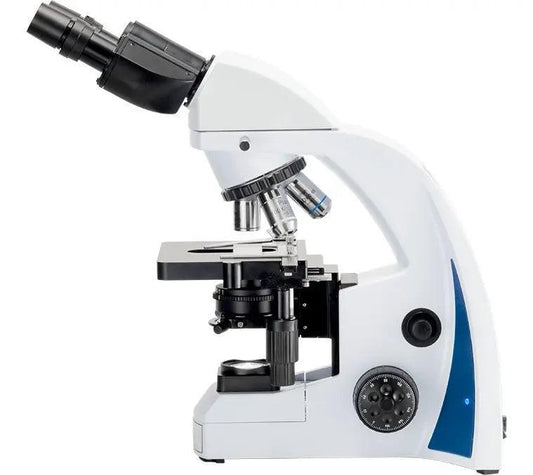
The compound microscope is used for viewing specimens at higher magnification. Again,
if you cannot see your specimen with the naked eye, you must use a compound microscope.
Typical magnifications are 40x, 100x, and 400x. The different objectives are mounted on
the nosepiece and are rotated to line up with the eyepiece. Each specific objective has
its own particular magnification. The microscope can be equipped with its own
illumination, or can be equipped with a mirror to reflect light through the eyepiece. It
may have either one or two eyepieces to view with, but unlike the stereo microscope, it
will not view the specimen in "3-D," only in two dimensions. Having two, or
binocular, eyepieces reduces eyestrain and enables you to work at ease much longer. (Most
lab microscopes are binocular.) Light must pass through the specimen and thus, the
specimen must be mounted on a slide. The microscope will have a focus adjustment, and the
better ones have both a coarse and fine focus. In the dark days before cable TV, some of
you may remember the fine tune adjustment on your television set. You set the dial to the
station, but "fine-tuned" it to get the best reception. This is much the same as
the fine focus. The coarse focus gets you close, the fine focus gets you closer. That is
not to say that you cannot focus with only the coarse, but it is much easier to have both
We offer six models of educational compound microscopes. Lets take a look at the
pros and cons of all of them.
The Travel Lab ($80)-- A very nice starter scope, built as all of our scopes with metal
construction and glass optics with a coarse focus. It is not a toy. Open the box and you
have all you need to get started: specimen containers, blank slides, starter kit with
stain and instruments and the "World of Microscope" book. It has a disc
diaphragm, which allows you to dial in via different diameter holes below the stage the
amount of light passing through the eyepiece. It is not self-illuminating, but uses a
mirror for reflected light. It does, however only offer one magnification, 200x, which
limits your viewing capacity.
The MicroQuest ($110)--Virtually identical in features and accessories as the Travel
Lab, but offers 40x, 100x and 400x magnifications. This is a plus. There is nothing you
cannot see with this microscope that you can see with our Explorer II or Observer III.
Both of the above are recommended for anyone of any age just starting out in
microscopy. They will offer years of enjoyment and are sturdily constructed. If your
budget is in the $100 range, you will be very pleased with either one. This is a good gift
idea also. However, if your child is in the age range of 10-12 years old and has exhibited
a more serious interest in science, you may be better served to invest in at least the
Explorer II.
The Explorer II, Observer III and Observer IV are the workhorses of our educational
lines. All are sold to both public and private schools throughout the country and are
built to be durable and forgiving. They are all built upon the same tough frame, but there
are some differences between them. Each has an adjustable iris diaphragm, which, like a
camera lens, is infinitely adjustable to increase or decrease the amount of light passing
through the eyepiece. This is a very important feature, because some specimens require a
lot of light, while others require very little. The ball-bearing head rotates 360 degrees
allowing viewing flexibility. All are self-illuminating, but include a mirror attachment
for field use.
The Explorer II ($164)--offers 40x, 100x and 400x magnification with coarse focus only.
It has a fixed Abbe condenser. This sturdy instrument is an excellent choice if your
budget does not allow for the Observer series. In every sense, it is a true educational
microscope. Perhaps its only limitation is the lack of a fine focus. Again, you can
focus on any object with this microscope, but at higher powers, it does become somewhat
more difficult.
The Observer III ($215) and IV ($260) are identical in every way except that the III
offers 40x, 100x and 400x magnification, while the IV offers an additional 1000x (oil
immersion) magnification. To view individual blood cells, you are required to have the
1000x oil immersion option. You could purchase the Observer III and add the 1000x later
for about $90, but it is cheaper to buy it with the Observer IV should it be a
requirement. Both offer coarse and fine focus for ease of use and have a moveable Abbe
condenser that offers unlimited adjustment of light control when used with the iris
diaphragm. This feature is usually found only on more expensive scopes. Either of these
will take a student through high school and will probably suffice the first year or two of
college. You will not find a better value than either the Observer III or IV.
We also offer the Observer IV Binocular Microscope ($435.) It is the same microscope as
the Observer IV but is mounted with a binocular head. These binocular microscopes are sold
into many universities for use by students who will be spending a lot of time viewing
specimens. If you are truly interested in pursuing microscopy, but your budget is not
quite in the $700 range, you will find this to be a very good investment.
As far as options, there are really none for the Achiever or Paragon. The MicroQuest
and Travel Lab include all you need in the kit, other than additional blank or prepared
slides. I would highly recommend the mechanical stage ($39) for the Explorer and Observer
series. It allows up/down and left/right manipulation of the slide by use of dial
calipers. It is almost a necessity at higher magnifications. It is easy to mount and
allows you to move the slide without having to look up from the eyepiece. The teaching
head ($49) is a good option that allows two people to view at the same time. In some
applications, i.e. the classroom, a teaching head is most helpful, but may be something to
add later if you are not quite sure. The Starter Kit ($21.95) and Stain Kit ($8) will add
to your enjoyment if you do not already have instruments, slides and teaching information.
The only problems we have encountered with the Observer and Explorer microscopes is
that sometimes the bulb is loose or broken due to shipment. When this happens we
immediately replace the bulb at no charge. Some have complained that the eyepiece is
cracked on the Explorer or Observer Series, but it actually is a pointer built into the
eyepiece. Again, another plus usually found on more expensive microscopes. Occasionally,
the stage will drift, or lower, on its own, but a phone call and simple adjustment takes
care of this problem. The microscopes have a one-year warranty on the electronics
(lighting) and a lifetime warranty against defects. If your microscope does not function
properly, it will be replaced.
Advances in medicine, computers and telecommunications have made the microscope a
prominent tool of research. Future job skills can only be enhanced by a working knowledge
of the microscope. Learn to use your instrument correctly, for not only could it be an
educational resource now, but it could also be a skill sought after by employers in the
future. A family usually purchases only one microscope and it does no one any good sitting
in the closet. If you invest in a microscope, use it to explore the incredible micro-world
that surrounds us. Take the time to find the best possible value. Our hope is that you
will find us to be a reliable source.
We want you to feel comfortable purchasing your microscope from Lab Essentials. We will
work hard to earn your respect and trust before, during, and after the sale. Remember, our
integrity is on the line with every order. We do not take this responsibility lightly!